Friction
The force that resists sliding, and why it does not depend on area.
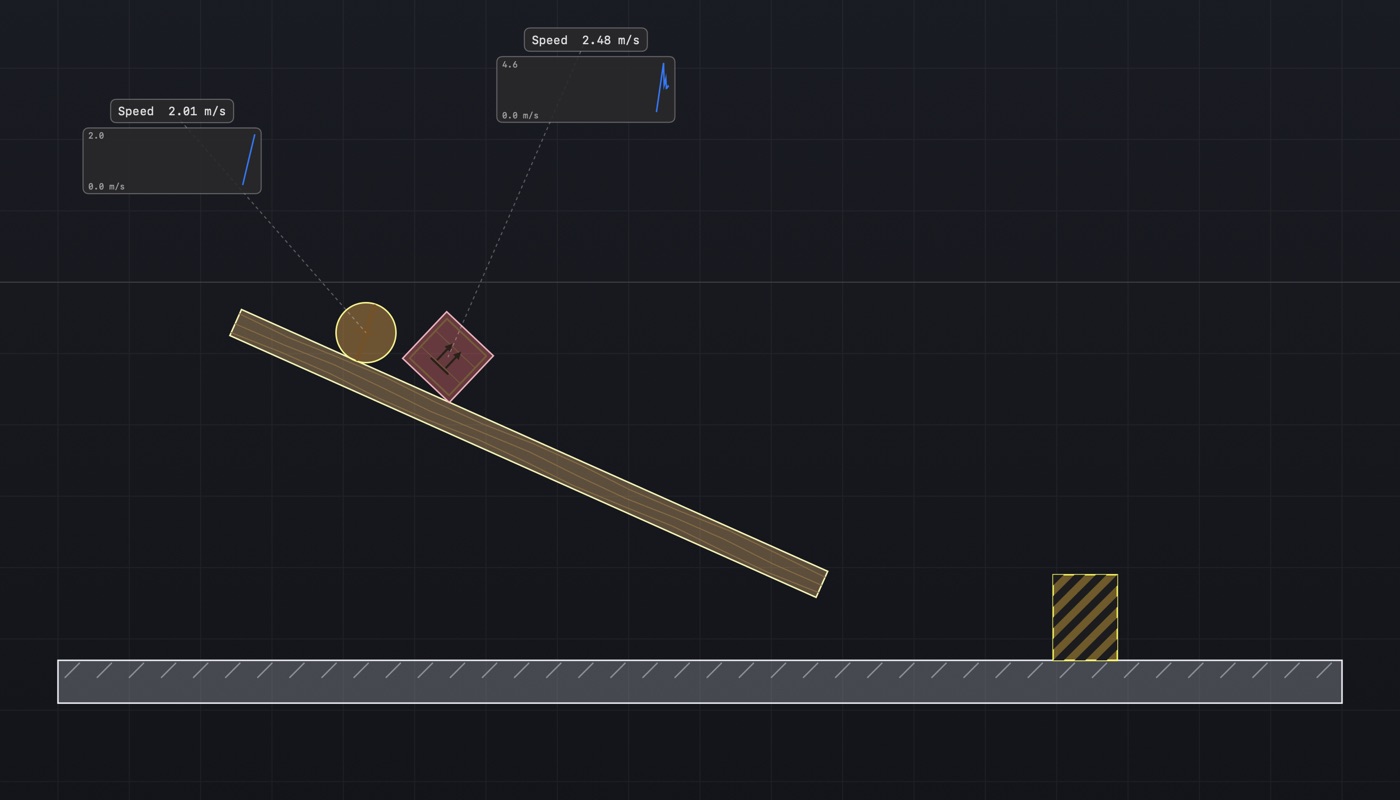
Friction between two surfaces is proportional to how hard they are pressed together and, to a good approximation, nothing else. Twice the load, twice the friction; twice the area of contact, the same friction, because the load is spread over twice as much.
There is more of it before something starts sliding than while it is sliding, which is why a heavy box goes suddenly rather than smoothly. A slope tells you the number directly: increase the angle until it slips, and the tangent of that angle is the coefficient.
| Quantity | Symbol | How it is worked out | Unit |
|---|---|---|---|
| Friction | F | coefficient × the force pressing them together | newtons |
| Slipping angle | θ | tan θ = the coefficient | degrees |
In the app every shape carries a friction number, and a contact between two shapes uses the square root of the product of theirs. A ball and a crate let go together on a slope arrive at different times, and the meters say why.
Open the ramp scene in the app to watch this one run.