Orbits
Falling and missing, and why the far ones go slower.
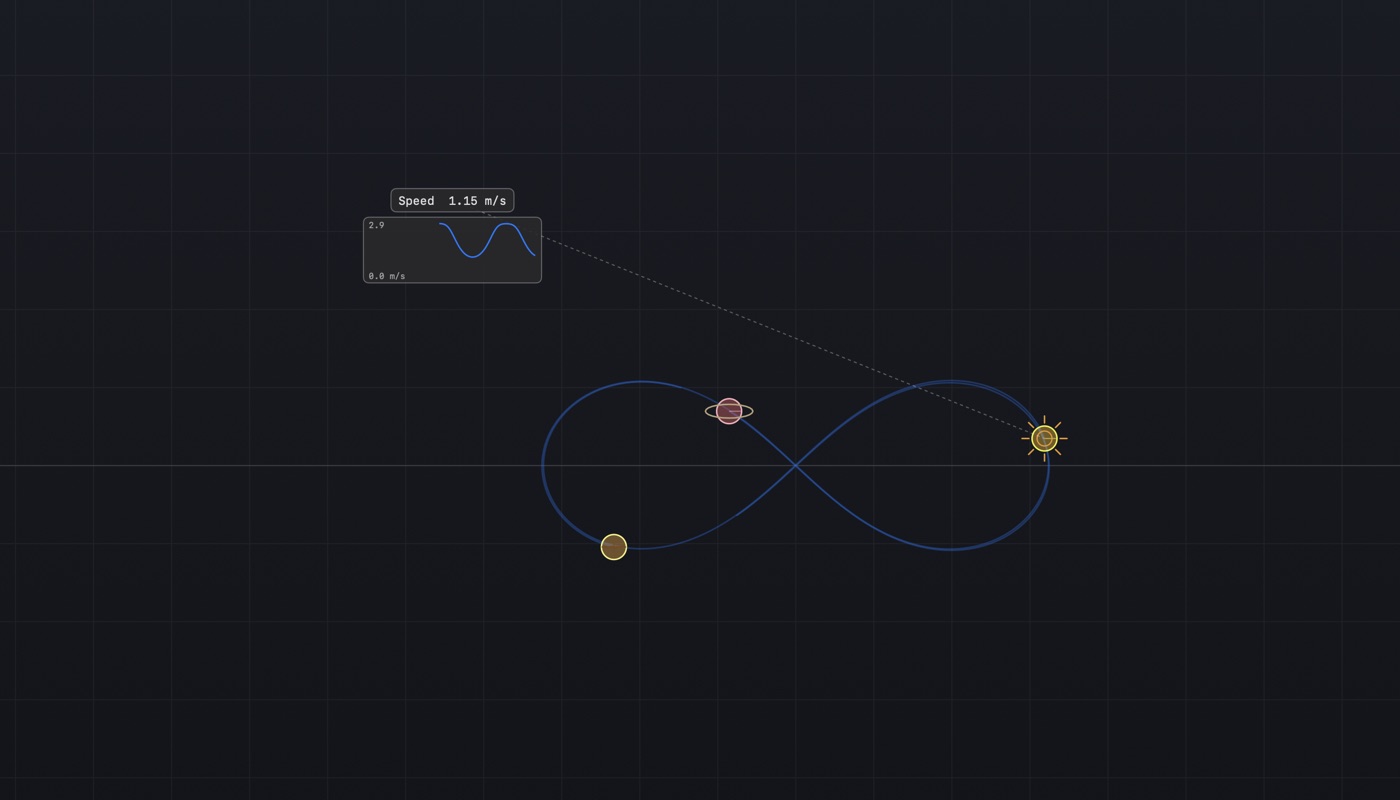
An orbit is a fall that keeps missing. Gravity pulls in proportion to the masses and inversely to the square of the distance, and the result is an ellipse with the heavy body at one focus rather than in the middle.
A body further out moves slower and takes much longer round: the period squared is proportional to the radius cubed, which is Kepler's third law and falls straight out of the inverse square.
| Quantity | How it is worked out |
|---|---|
| Attraction | G × m₁ × m₂ ÷ distance² |
| Circular speed | √(GM ÷ r) |
| Period | T² ∝ r³ |
The app has attraction between all bodies as a board setting rather than a force you draw. Turn gravity down to nothing, turn attraction up, and give something a sideways push.
Open the orbits scene in the app to watch this one run.