Springs
A force in proportion to how far it is pulled, and what that does.
A spring pushes back in proportion to how far it is stretched or squashed: that is Hooke's law, and it is why a spring bounces rather than simply moving. Together with a mass it makes an oscillator whose frequency depends on the stiffness and the mass and nothing else.
A damper is the other half of a suspension. It takes energy out in proportion to how fast the ends are moving apart, which is what stops a car bouncing all the way down the road after one bump.
| Quantity | Symbol | How it is worked out | Unit |
|---|---|---|---|
| Spring force | F | stiffness × stretch | newtons |
| Frequency | ω | √(stiffness ÷ mass) | radians a second |
| Damper force | F | damping × speed apart | newtons |
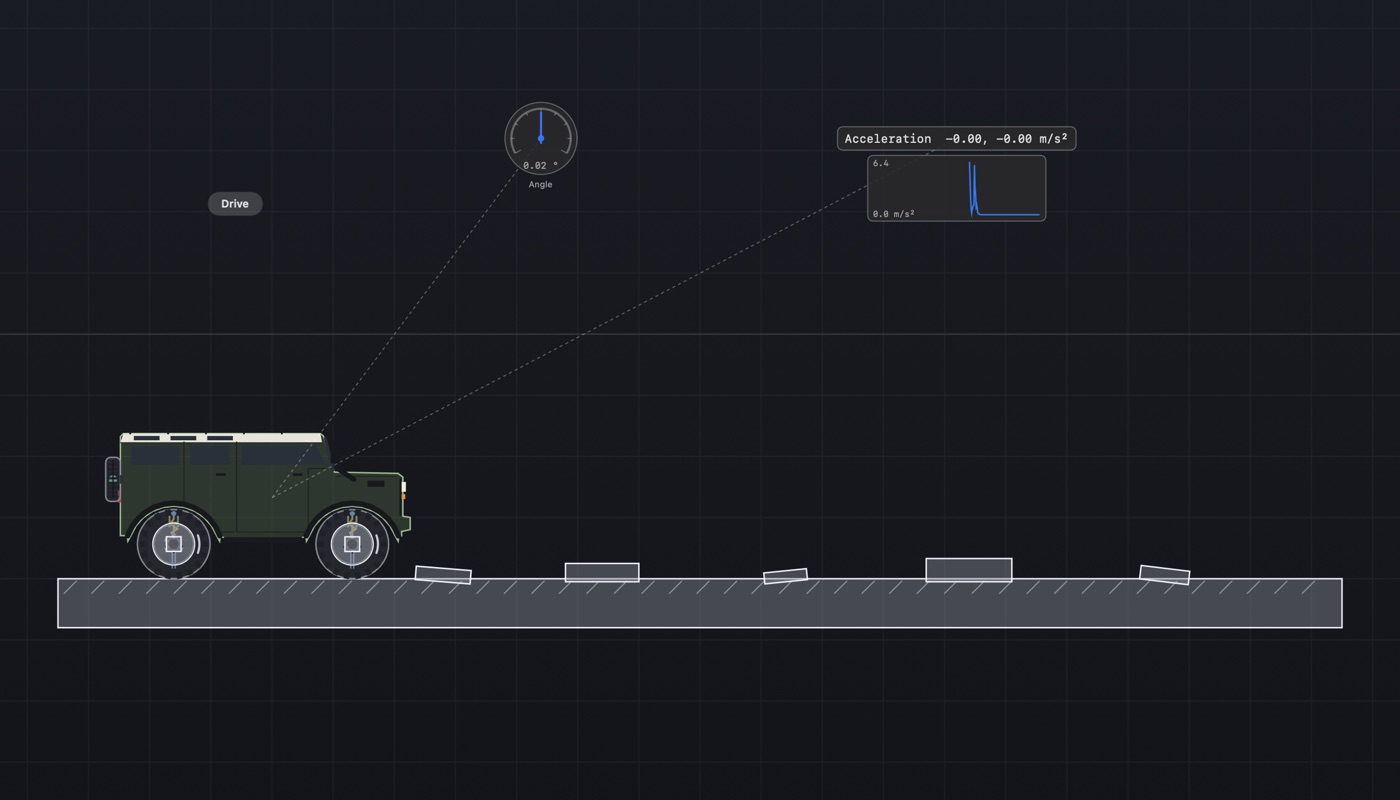
The pickup in the app has a spring and a damper on each wheel. Take the damping out and drive it over the rough ground.
Open the car scene in the app to watch this one run.