Materials that give
What it means for something to be soft, and what it looks like.
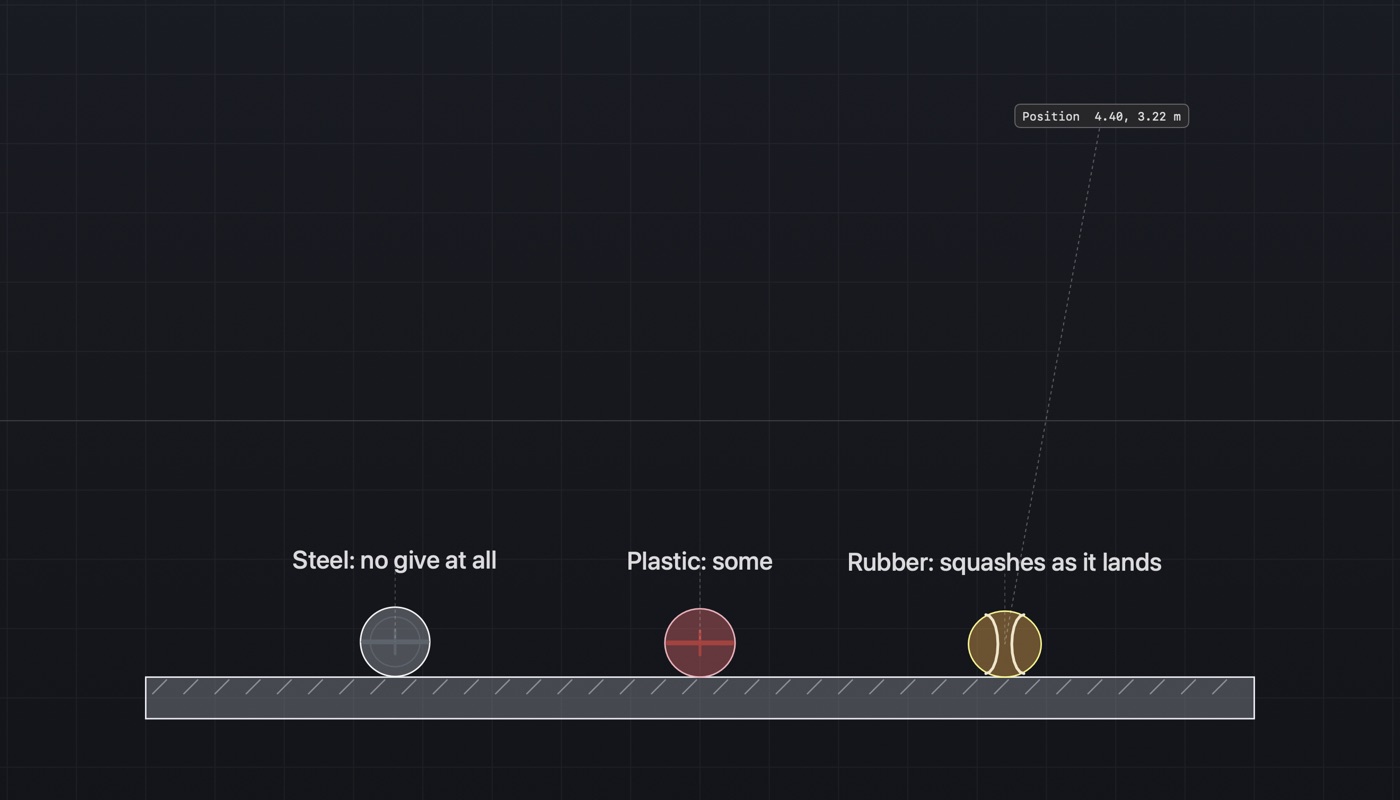
Everything in a rigid body simulator is, by construction, rigid: shapes never change shape. Real ones do. A rubber ball flattens against the floor as it lands and pushes itself back off; a steel one does not.
The honest way to do this without becoming a finite element package is a soft contact: instead of a wall that stops a shape dead, a spring that gives and pushes back in proportion. The amount of give is what a material is soft by.
| Material | Gives | What it does |
|---|---|---|
| Steel, glass | nothing worth drawing | stops dead |
| Wood | a little | mostly the grain |
| Plastic | some | visibly, on a hard landing |
| Rubber | a great deal | squashes and springs back |
A ball at rest gives by about a hundredth of itself, which is right and not much to look at. The squash worth watching is the one at the moment of landing, which is ten times bigger, and the app draws it: shortened along the press and stretched across it, keeping the area, which is what a solid does.
Open the soft scene in the app to watch this one run.