Momentum and collisions
What is kept when things hit each other, and what is not.
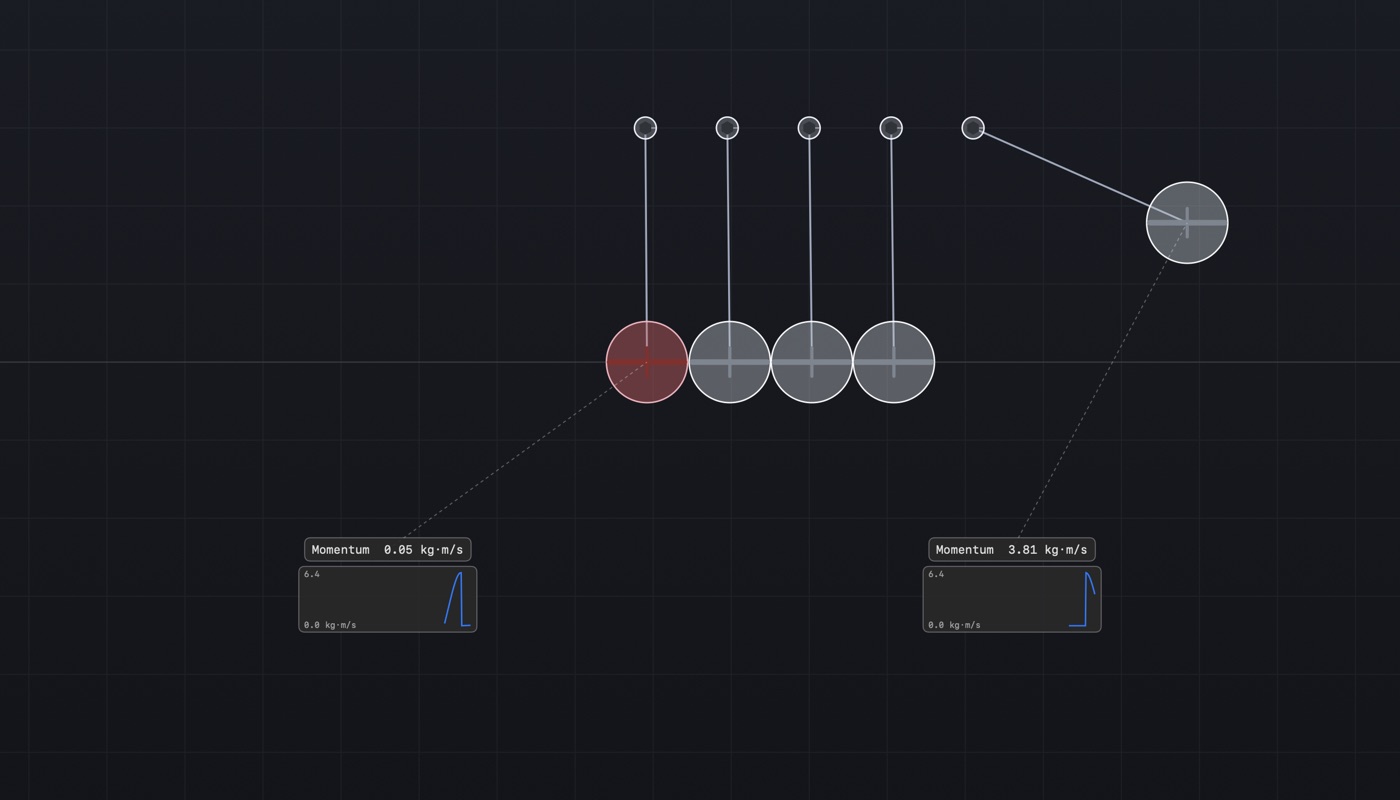
Momentum is mass times velocity, and the total of it never changes in a collision: whatever one body gains the other loses. Energy is not so well behaved. In a perfectly elastic collision the kinetic energy is kept too; in a real one some of it goes into heat, sound and bending, and the bodies come apart slower than they came together.
How much survives is the coefficient of restitution: the speed they separate at divided by the speed they closed at. One is a perfect bounce, nothing is a collision where they stay together.
| Quantity | Symbol | How it is worked out | Unit |
|---|---|---|---|
| Momentum | p | mass × velocity | kilogram metres a second |
| Kinetic energy | E | ½ × mass × speed² | joules |
| Restitution | e | speed apart ÷ speed together | none |
Newton's cradle is the demonstration everybody knows and almost nobody can explain from momentum alone: momentum would be conserved if two balls left at half the speed, and they do not. Energy is what rules that out. Set the bounce on the balls to one and watch it run for ever; set it to a half and watch it die.
Open the cradle scene in the app to watch this one run.