Gear ratios
Trading speed for turning force, and the price of it.
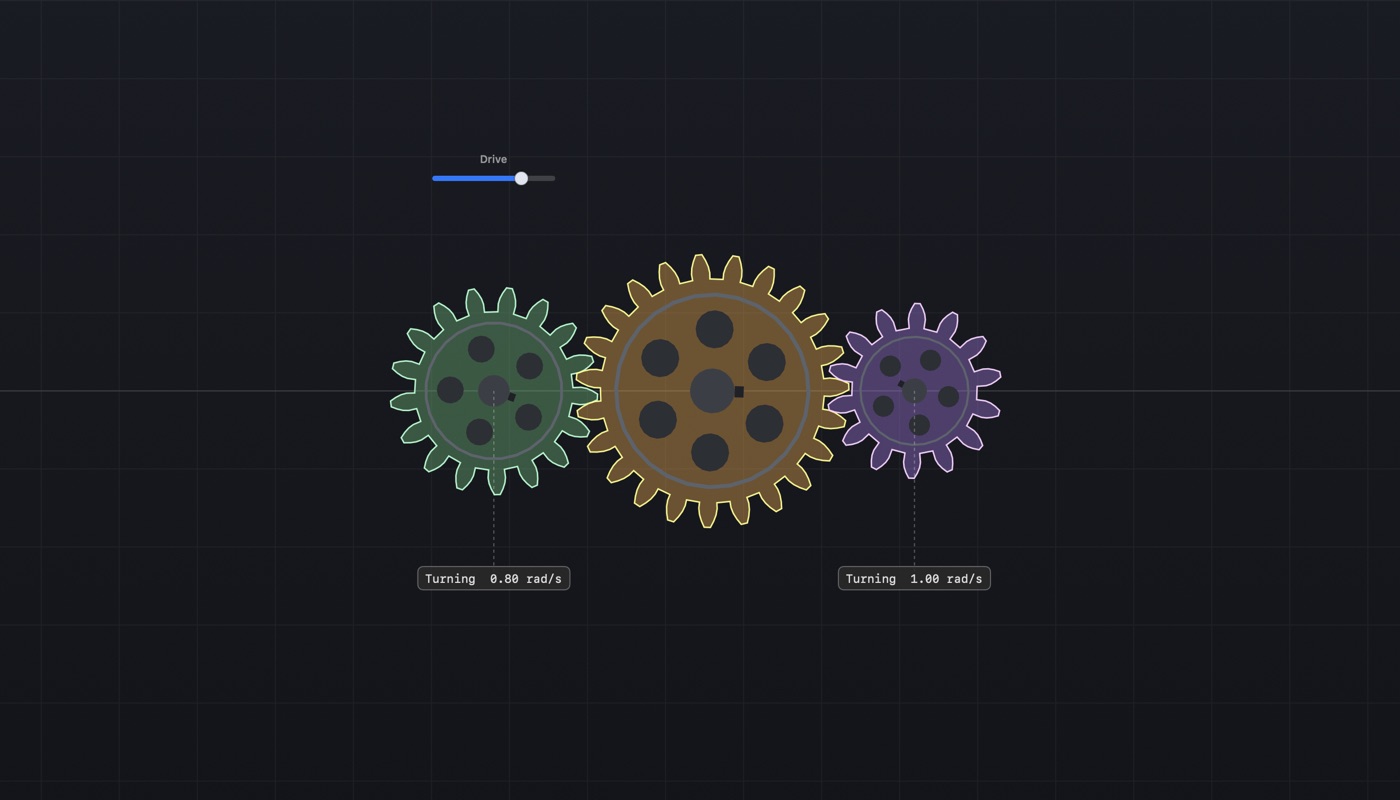
Two gears in mesh turn at speeds in inverse proportion to their tooth counts. A ten tooth gear driving a thirty tooth gear turns it a third as fast and with three times the torque. Nothing is gained: the power going in is the power coming out, less what friction takes.
Teeth are what matters, not size, because two gears that mesh have the same tooth spacing by definition. A train of gears multiplies: three pairs of three to one is twenty seven to one.
| Quantity | How it is worked out |
|---|---|
| Speed ratio | teeth on the driver ÷ teeth on the driven |
| Torque ratio | the other way up |
| An idler between them | changes the direction, not the ratio |
The gear train in the app is four gears driven by a motor, with a meter on each shaft. The numbers on the meters are the tooth counts, upside down.
Open the gears scene in the app to watch this one run.