Involute teeth
The shape a gear tooth has to be, and why any other shape knocks.
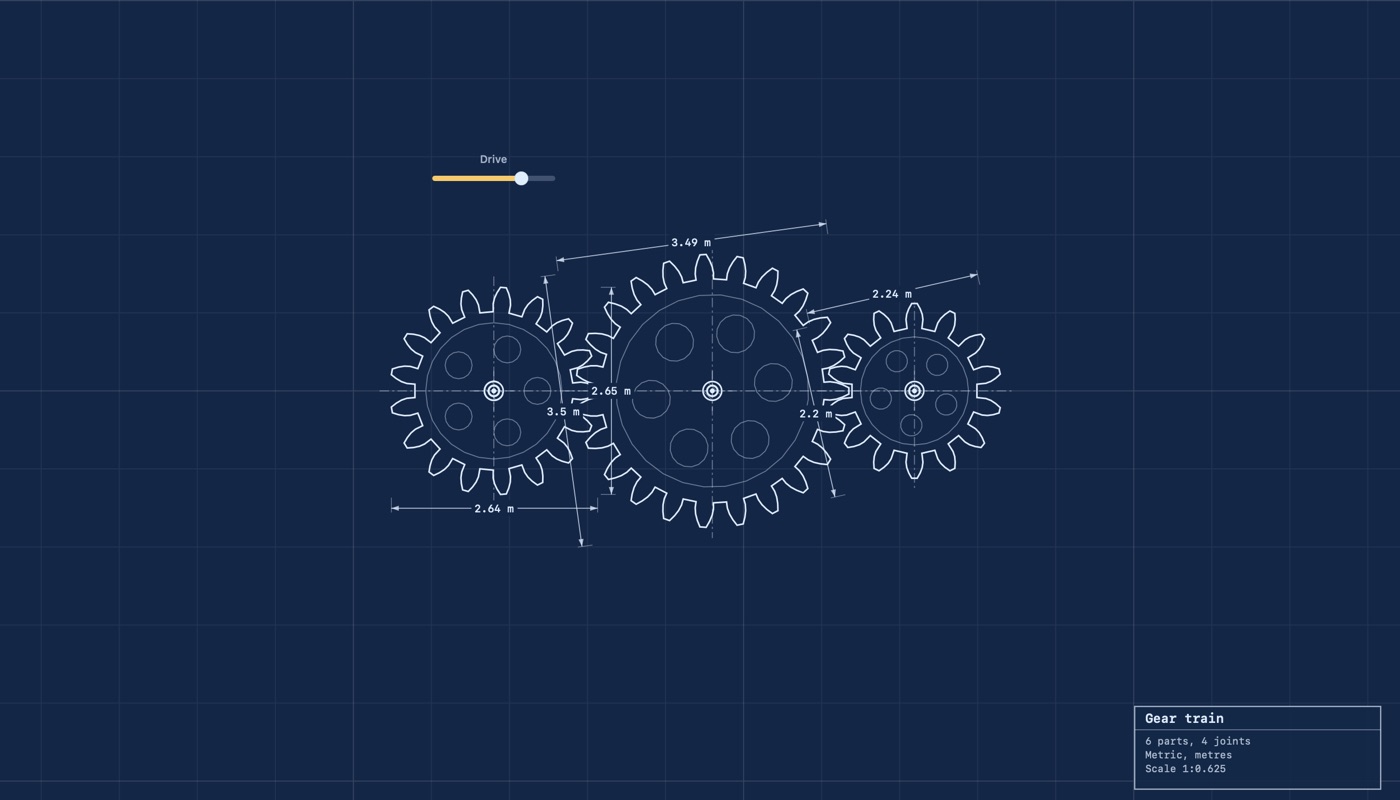
A gear tooth is not a triangle or a rectangle. It is an involute: the curve a taut string traces as it unwinds from a circle. That shape has one property no other has — two involute teeth in contact push each other along a line that never moves, whatever the angle they are at.
That is what makes gears turn smoothly. Any other tooth shape changes the ratio slightly as the teeth roll past each other, so a shaft driven through them speeds up and slows down within every tooth, and a train of them sings.
| Quantity | Symbol | What it means |
|---|---|---|
| Module | m | tooth size: pitch diameter ÷ teeth |
| Pressure angle | α | the angle of the line the teeth push along, usually 20° |
| Pitch diameter | d | m × teeth |
The app draws real involute teeth and the gears drive each other by touching, not by an invisible rule that keeps them in step. The icon in the palette is drawn by the same code that makes the gears.
Open the gears scene in the app to watch this one run.