The slider crank
Turning into sliding, which is every engine ever built.
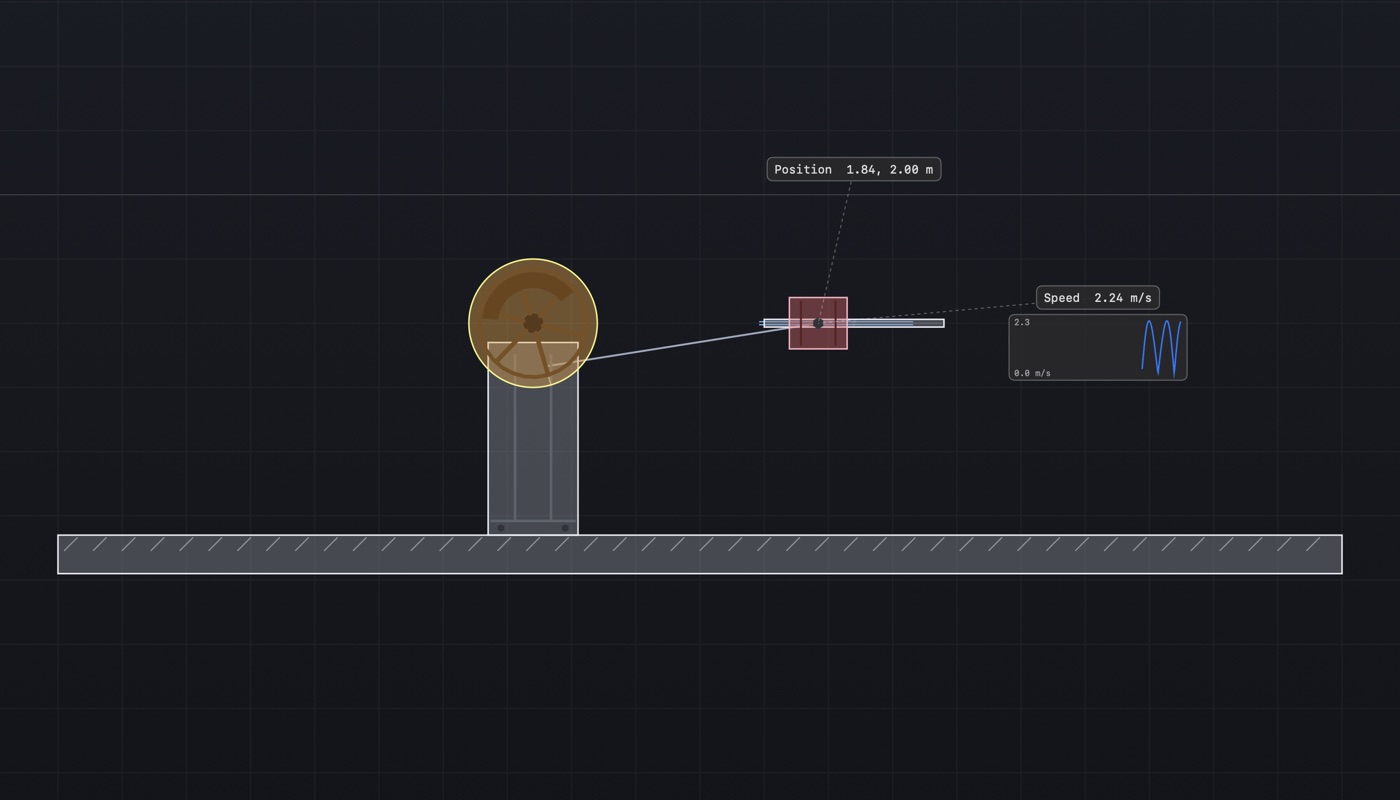
A crank, a rod and a slider: the mechanism inside every piston engine and every pump. The crank turns steadily and the slider does not move steadily at all — it is quickest halfway along and stops dead at each end, and it spends longer at one end than the other unless the rod is very long.
The travel is twice the crank throw, whatever the rod length. The rod length changes how uneven the motion is, not how far it goes.
| Quantity | How it is worked out |
|---|---|
| Travel | 2 × the crank radius |
| Slider position | r cos θ + √(l² − r² sin² θ) |
Put a meter on the slider in the app and graph its position against time. It is nearly a sine wave, and the way it is not is the rod length.
Open the crank scene in the app to watch this one run.